Key Takeaways
- Compare fulfillment companies by operating model, not brand size alone.
- Warehouse count matters less than whether inventory is positioned in the right markets.
- Shipping reliability should be judged by consistency, visibility, and exception handling — not headline speed.
- Pricing should be compared on total fulfillment cost, not only pick-and-pack fees.
- Product complexity, integrations, support, and scalability can matter as much as shipping rates.
- The best 3PL is the provider whose capabilities match the operational problems your business actually needs to solve.
Quick Answer: How Should Ecommerce Brands Compare Fulfillment Companies?
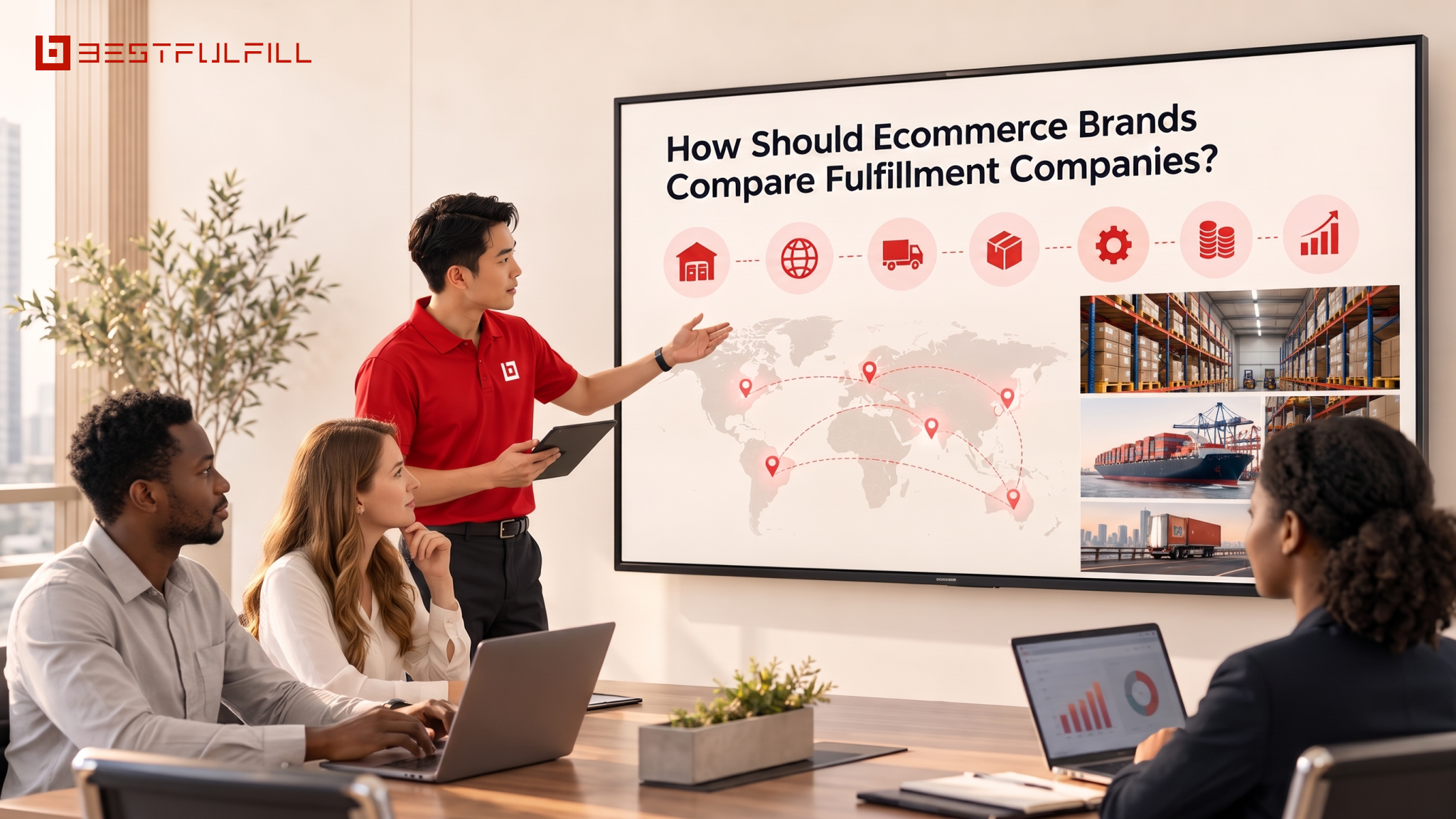
Compare providers across seven areas:
- Fulfillment model and service scope
- Warehouse and market coverage
- Shipping reliability
- Technology and integrations
- Product and order complexity
- Pricing and contract structure
- Support, exception handling, and scalability
Weight these factors according to your actual operating model rather than using the same checklist for every brand.
The best fulfillment company is the one whose operating model matches your products, markets, and order complexity — not simply the provider with the largest network.
For a broader provider shortlist, see Best 3PL Companies for Scaling Ecommerce Brands in 2026.
Ecommerce Fulfillment Company Comparison
| Provider | Best Fit | Core Strength | Fulfillment Model | Key Consideration |
| Bestfulfill | Scaling global ecommerce brands | Sourcing, QC, branded fulfillment, global logistics | Full-service ecommerce fulfillment | Best when brands want fewer handoffs across the supply chain |
| ShipBob | Small-parcel DTC brands | Distributed inventory and technology-led fulfillment | Multi-node ecommerce 3PL | Best suited to relatively standardized fulfillment workflows |
| ShipMonk | Subscription, bundle, and kitting-heavy brands | Flexible order workflows | Ecommerce 3PL | Strong fit for complex DTC order configurations |
| Red Stag Fulfillment | Heavy, bulky, fragile, or high-value goods | Specialized handling and accountability | Specialist 3PL | Less relevant for lightweight global ecommerce |
| Stord | Larger omnichannel brands | Integrated warehousing and transportation | Enterprise logistics network | May be more infrastructure than smaller DTC brands need |
| Flexport | Brands with international freight needs | Global freight and supply-chain coordination | Freight and logistics platform | Strongest when international freight is a major requirement |
The 7 Factors That Actually Matter

Fulfillment Model and Service Scope
Not every fulfillment company solves the same part of the supply chain.
Some 3PLs focus mainly on warehousing, picking, packing, and shipping. Others also support sourcing, quality control, product preparation, custom packaging, or international logistics.
The more complex your supply chain, the more important service scope becomes.
Ask:
- Does the provider only handle warehouse fulfillment?
- Who manages sourcing, QC, labeling, or product preparation?
- Can branded packaging, kitting, or returns be managed within the same workflow?
For brands that source products and fulfill orders across multiple markets, fewer operational handoffs can simplify coordination.
Warehouse and Market Coverage
More warehouses do not automatically create better fulfillment.
What matters is whether the provider's network matches where your customers actually are.
For example, ShipBob currently operates 50+ fulfillment centers globally and uses distributed inventory to help reduce shipping zones and transit times. ShipBob fulfillment center locations
A brand selling mainly in one market may benefit from centralized inventory. A multi-country brand may need a combination of origin-country inventory and local stock in key markets.
Ask:
- Which warehouses would actually serve my customers?
- How would inventory be distributed across locations?
- What happens if demand shifts between markets?
The strongest network is not necessarily the largest one.
It is the network that fits your demand.
If international routes and inventory handoffs are a major part of your model, see How to Choose a Cross-Border Fulfillment Partner for Ecommerce Brands Sourcing from China in 2026.
Shipping Reliability
Fast shipping and reliable shipping are not the same thing.
A provider may advertise short delivery times, but reliability depends on whether orders consistently meet the promised window and whether problems are handled when they occur.
Look at:
- On-time fulfillment
- Tracking visibility
- Carrier and route options
- Exception detection
- Escalation ownership
- Peak-season performance
Some providers publish operational performance directly. ShipBob, for example, currently reports approximately 99.97% fulfillment accuracy alongside delivery and click-to-delivery performance data. ShipBob performance data
Ask:
- How is shipping performance measured?
- What happens when tracking stops updating?
- Who owns delayed, lost, or failed shipments?
Reliability is ultimately about consistency + visibility + operational ownership.
Technology and Integrations
Technology should reduce manual work, not add another layer of complexity.
At minimum, brands should have visibility into orders, inventory, and fulfillment status.
Shopify's Fulfillment Network, for example, allows merchants to connect with 3PL partners and manage inventory transfers, order fulfillment, and tracking through the Shopify admin. Shopify Fulfillment Network
For multi-market operations, routing logic and inventory synchronization become even more important.
Ask:
- Which ecommerce platforms do you integrate with?
- Is inventory updated in real time?
- Can orders be routed across multiple fulfillment locations?
- How are cancellations, edits, and exceptions handled?
The best technology is not necessarily the platform with the longest feature list.
It is the system that gives your team the visibility and control it actually needs.
Shopify brands can also compare provider models in Best Shopify 3PL Fulfillment Companies for Growing Ecommerce Brands in 2026.
Product and Order Complexity
A provider that performs well for simple apparel orders may not be the right fit for oversized goods, custom bundles, subscription boxes, or regulated products.
Consider:
- Product size and weight
- SKU count
- Fragility
- Kitting and bundles
- Custom packaging
- Inserts and personalization
- Special handling requirements
- Returns
Red Stag specializes in big, heavy, bulky, and high-value products and backs key fulfillment commitments with financial guarantees. Red Stag Fulfillment
Ask:
- How much experience do you have with products like ours?
- Can custom packaging or kitting scale with volume?
- How are returns inspected and restocked?
Product fit is one of the easiest factors to underestimate during 3PL selection.
For brands where packaging, kitting, and branded orders are major requirements, see Best Fulfillment Companies for Custom Packaging and Branded Orders in 2026.
Pricing and Contract Structure
The cheapest pick-and-pack rate does not necessarily produce the lowest fulfillment cost.
Compare the complete cost structure:
- Receiving
- Storage
- Pick and pack
- Packaging
- Shipping
- Returns
- Special projects
- Minimums
- Peak surcharges
- Long-term storage
- Contract commitments
Ask:
- Can you provide an itemized sample invoice?
- Which fees change as volume grows?
- Are there monthly minimums or long-term commitments?
- What happens when order volume drops?
The right comparison is total cost per fulfilled order, not one headline fee.
Support, Exception Handling, and Scalability
Fulfillment providers are easiest to evaluate when everything is running normally.
The real test comes when something goes wrong.
Peak-season spikes, inventory discrepancies, carrier delays, new market launches, and sudden volume growth expose whether a provider has clear operational ownership.
Ask:
- Who handles day-to-day operational issues?
- What is the escalation process?
- How are urgent exceptions communicated?
- Can the provider support new markets, SKUs, and higher order volumes without major disruption?
A provider should not only support today's business.
It should be able to support the next stage of growth.
How the Main Ecommerce Fulfillment Providers Differ
Bestfulfill
Bestfulfill connects sourcing, QC, branded fulfillment, warehousing, and global shipping within one ecommerce fulfillment model.
Best fit: Scaling ecommerce brands that want fewer handoffs between upstream supply-chain operations and fulfillment.
ShipBob
ShipBob uses a distributed, technology-led fulfillment model across a global warehouse network.
Best fit: Small-parcel DTC brands with relatively standardized fulfillment requirements.
ShipMonk
ShipMonk focuses on more complex ecommerce workflows, including subscriptions, bundles, and kitting.
Best fit: Brands with recurring or highly customized order configurations.
Red Stag Fulfillment
Red Stag specializes in heavy, bulky, fragile, and high-value products.
Best fit: Products where damage, handling errors, or oversized shipments create significant cost.
Stord
Stord combines warehousing, transportation, and omnichannel logistics.
Best fit: Enterprise brands coordinating ecommerce, retail, and broader distribution requirements.
Flexport
Flexport combines ecommerce fulfillment with international freight and global supply-chain coordination. Its ecommerce fulfillment network supports shipping to 200+ countries and territories. Flexport ecommerce fulfillment
Best fit: Brands where international freight, import coordination, and global logistics are major requirements.
Best Fulfillment Company by Scenario
| Scenario | Priority | Providers Worth Comparing |
| Scaling ecommerce brand | Reliable operations + scalability | Bestfulfill, ShipBob |
| Global / cross-border brand | International coordination + market coverage | Bestfulfill, Flexport |
| Shopify DTC brand | Integration + small-parcel fulfillment | ShipBob, Bestfulfill |
| Heavy or high-value goods | Handling accuracy + damage control | Red Stag Fulfillment |
| Complex kitting / subscriptions | Flexible order workflows | ShipMonk |
| Enterprise omnichannel | Warehousing + transportation + retail | Stord |
The point is not to identify one universal winner.
It is to narrow the shortlist based on the operational problem that matters most.
Red Flags When Comparing Fulfillment Companies
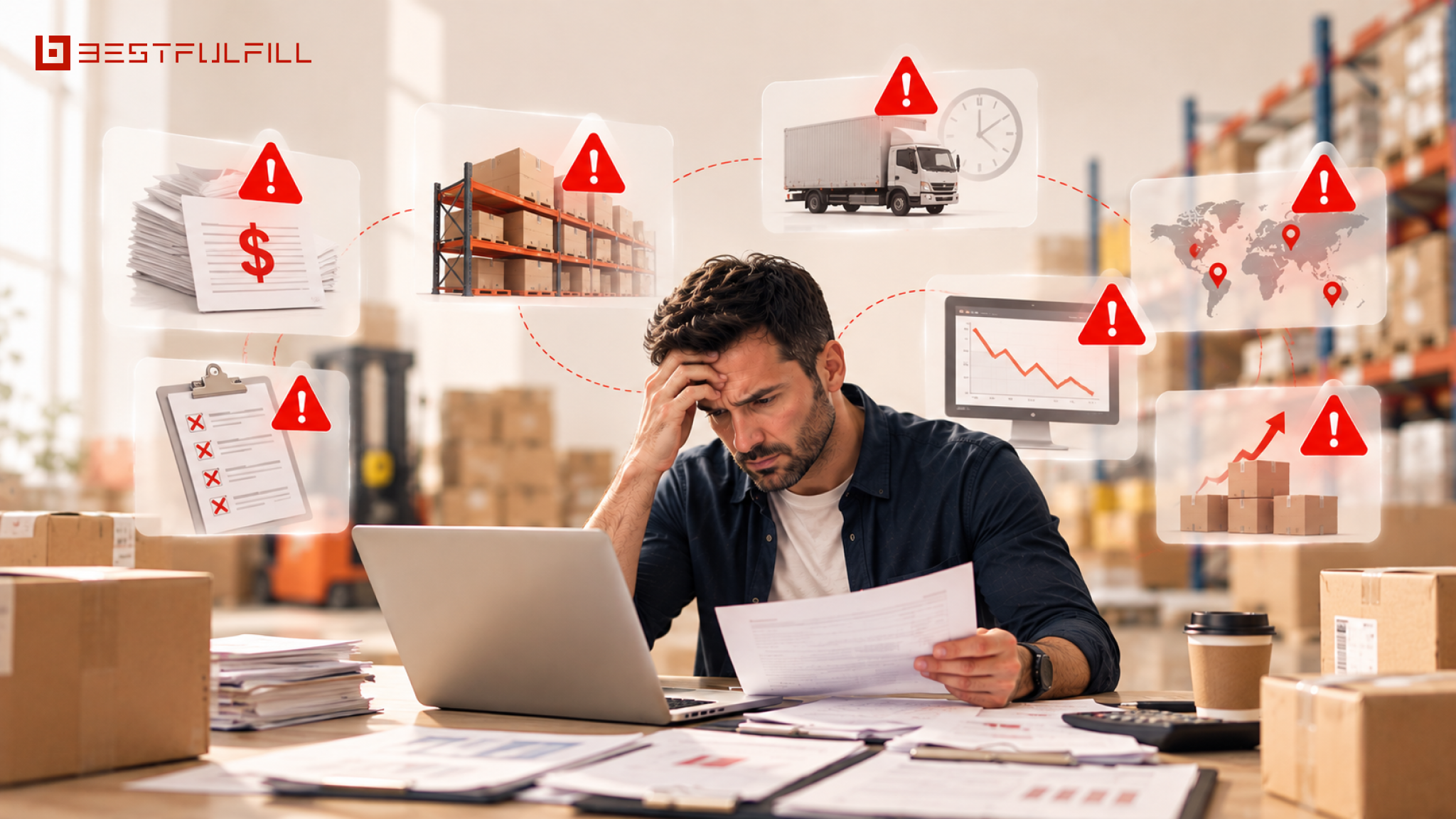
Watch for providers that:
- Cannot explain their full pricing structure
- Have vague fulfillment or shipping SLAs
- Provide limited inventory visibility
- Have no clear owner for operational exceptions
- Cannot explain how peak-season capacity is managed
- Have little experience with your product type
- Lack coverage in your priority markets
A provider that looks inexpensive during the sales process can become expensive once operational problems begin.
Final Takeaway
Choosing a fulfillment company is ultimately an operating-model decision.
Warehouse count, shipping rates, and software features all matter — but only when they support the way your business actually works.
Start with your products, markets, order profile, and growth plans.
Then choose the provider whose fulfillment model removes the most operational friction from your business.
Compare the operating model first. Compare the logo second.
Frequently Asked Questions (FAQ)
What are the best 3PL fulfillment companies for ecommerce in 2026?
Providers worth comparing include Bestfulfill, ShipBob, ShipMonk, Red Stag Fulfillment, Stord, Flexport, and relevant regional specialists.
The strongest option depends on the operating model. Bestfulfill is relevant for global brands needing sourcing and fulfillment connected together, ShipBob for distributed DTC fulfillment, ShipMonk for complex order workflows, and Red Stag for heavy or high-value goods.
Who are the top fulfillment service providers for ecommerce?
Bestfulfill, ShipBob, ShipMonk, Red Stag Fulfillment, Stord, and Flexport represent several different ecommerce fulfillment models.
Rather than ranking them by company size alone, compare service scope, market coverage, shipping reliability, product fit, technology, pricing, and support.
What is the best way to choose a 3PL fulfillment provider?
Start by defining your operational requirements.
Then compare providers across fulfillment model, warehouse coverage, shipping reliability, technology, product complexity, total cost, and operational support.
Shortlist providers based on fit before comparing price.
Should I use one 3PL or multiple fulfillment providers?
It depends on your market coverage and operational complexity.
A single 3PL can simplify inventory, systems, and accountability. Multiple providers may make sense when different regions, product types, or sales channels require specialized capabilities.
For multi-market brands, add another provider only when it solves a clear operational gap that the existing partner cannot cover efficiently.
Should I choose a global 3PL or a regional fulfillment provider?
A global 3PL is usually more useful when you sell across multiple markets and need centralized coordination.
A regional provider may be stronger when local carrier relationships, returns, delivery preferences, or market-specific requirements matter more.
Some brands use a global provider for core operations and add regional specialists only where they solve a specific gap.
Is the cheapest 3PL usually the best option?
No.
A lower fulfillment fee can be offset by higher shipping costs, inventory errors, hidden charges, poor support, or operational inefficiency.
Compare total fulfillment cost and operational impact rather than one unit price.
How important is warehouse location when choosing a fulfillment company?
Warehouse location affects transit time, shipping zones, inventory allocation, and market coverage.
However, more locations can also create more inventory complexity.
Choose locations based on actual customer demand rather than warehouse count alone.
When should an ecommerce brand switch fulfillment providers?
Common triggers include repeated SLA failures, poor communication, limited market coverage, weak technology, rising hidden costs, or an inability to support new products and markets.
A provider should continue to fit the business as the operating model evolves.